Seven is often the age when children begin to enjoy gaming as a genuinely social activity rather than something they do alone. They understand simple goals, can follow short instructions and are usually excited by the idea of playing alongside their classmates. At the same time, they still benefit from structure, encouragement and regular changes of activity.
A successful gaming party for a 7 year old therefore needs more than a row of screens. It needs a clear rhythm that helps every child join in, even if some guests are experienced players and others have barely held a controller.
For parents, the attraction is easy to understand. A gaming party can work in a living room, community hall or hired venue, it does not depend on the London weather, and the entertainment can be adapted to the group. The key is to plan for the children who are actually attending.
Seven-year-olds are enthusiastic, but their concentration can move quickly. Short rounds, recognisable games, patient explanations and fair player changes are much more valuable than complicated tournaments that leave half the group watching.
The best result feels exciting without becoming chaotic. Children should know where to sit, when their turn is coming and who can help if a game is unfamiliar. A professional host can manage those details while parents concentrate on welcoming guests, arranging food and enjoying the birthday. With the right setup, the party becomes a shared experience rather than several separate children disappearing into different games.
Game choice should begin with accessibility. A title may be popular, but that does not automatically make it suitable for a mixed group of seven-year-olds. Look for games with clear controls, quick restarts and rounds that do not last too long.
Racing, football, party games and cooperative challenges often work well because a new player can understand the objective almost immediately. The host can demonstrate the basic controls before the first round and then help anyone who needs extra support.
It is also important to consider age ratings and the preferences of the families attending. Ask the birthday child which games they love, but make the final list broad enough for different abilities. Some children enjoy competition, while others are happier building, exploring or working as a team. A balanced plan could include a racing station, a sports game, a colourful party title and a cooperative option. This gives guests a choice without creating so many options that the group becomes fragmented.
Avoid making elimination the main feature. A child who loses in the first minute should not have to wait fifteen minutes to play again. Use short heats, team points or rotating stations instead. Adults sometimes assume that a tournament must end with one champion, but at this age the more useful goal is to give everyone a memorable moment. Small awards can recognise teamwork, encouragement, a funny comeback or the most improved player as well as the highest score.
A focused gaming session of around ninety minutes is usually a strong starting point for this age. It provides enough time for several games and rotations without expecting children to concentrate for an entire afternoon. If food, cake and presents are part of the celebration, the full booking at the venue may need to be longer, but the structured gaming portion can remain compact. A clear schedule also helps parents state accurate collection times on the invitation.
A practical flow begins with ten minutes for arrival and introductions, followed by a simple warm-up game. The main play period can be divided into blocks of fifteen to twenty minutes, with children rotating between stations. A short water or snack break can reset the room before a final team challenge. Cake is often easier after the gaming equipment has been paused, because controllers and food are not a good combination. Leave a little spare time at the end for photographs, coats and late collections.
Do not plan every minute so tightly that one technical delay causes stress. Consoles and displays should be installed and tested before guests begin playing, but children may still need longer to settle or choose teams. Build in a small buffer. A confident host can shorten one round, extend a popular activity or change the groupings while still finishing on time.
A seven-year-old may play games every day, while one of their friends may not have a console at home. That difference matters. If teams are chosen only by the children, the confident players can group together and the beginners may feel exposed. Instead, use balanced teams and explain that the purpose is to play together. Pairing a confident child with a newer player can work well when the experienced child is encouraged to help rather than take over.
The host should make instructions short and visible. Explain one control at a time, begin the game and give extra guidance during play. Long technical briefings are quickly forgotten. It is also helpful to have at least one activity that does not rely on previous gaming knowledge, such as a simple racing challenge where everyone uses the same controls. This gives new players a fair chance to succeed and often produces the loudest cheering of the party.
Rotations should be announced before anyone feels they are being removed from a game. For example, tell the group that each round lasts ten minutes and that everyone will move clockwise when the timer finishes. Children are much more willing to swap when the rule applies to everybody and the next turn is predictable. If a guest needs a quiet moment, allow them to watch, have a drink and rejoin without drawing attention to it.
You do not need a huge venue, but you do need usable space. Think about where screens, consoles, seats, cables and walking routes will go. Children should not have to step over wires to reach the toilet or food table. Power sockets must be accessible and the room should have enough ventilation, especially when several screens and excited guests are in one place. A clear floor area is more important than decorative furniture, so consider moving coffee tables and fragile ornaments before setup begins.
Ask the provider what is included. A hosted package may supply consoles, monitors, controllers, games, racing equipment and a party host. Confirm how many children can play simultaneously and how rotations are managed. Six children can enjoy a smaller arrangement, while a larger class group may need multiple stations. More equipment is not always automatically better. The setup should match the room and allow the host to supervise every station properly.
Reliable internet may be useful, but the party should not depend entirely on downloading updates at the venue. Games and consoles should be prepared in advance. If your home Wi-Fi is weak, tell the provider before the event. The most dependable party plan uses locally available multiplayer games and treats online features as an extra rather than the foundation of the afternoon.
The invitation should tell parents that gaming is the main activity, give the exact address and collection time, and request any information about allergies or additional support. It can also ask guests to arrive promptly because the host will explain the stations at the beginning. There is no need to ask children to bring consoles or controllers unless your provider specifically requests it. Keeping all equipment under one organised setup reduces confusion and protects personal devices from being mixed up.
Choose food that can be served away from the equipment. Pizza slices, small sandwiches, fruit and clearly labelled drinks are easier than sauces or snacks that leave sticky hands. Schedule a hand-washing break before children return to the controllers. If the party is ninety minutes, some families prefer to serve cake immediately afterwards rather than interrupt the gameplay. Whatever you choose, tell the host so the final challenge can finish at the right time.
Decorations can borrow colours or symbols from the birthday child’s favourite games without needing expensive licensed products. Coloured tableware, pixel-style name cards and a simple scoreboard can create the theme. Party bags might include a small puzzle, stickers or a printed achievement certificate. The gaming experience should remain the main event, so extras do not need to compete with it.
The following are fictional planning examples created to show how the same service could be adapted to different London locations. They are not descriptions of actual customers or completed events.
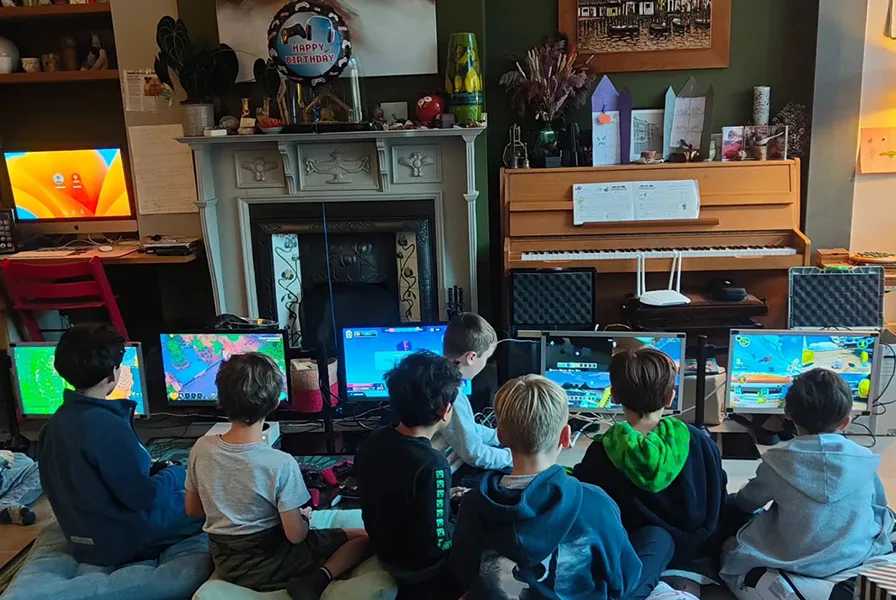
Bromley home party example. Imagine eight children gathering in a family living room for a seventh birthday. The furniture is moved to create a safe central walkway, with four gaming monitors positioned along two walls. The session opens with simple team racing, followed by short football and party-game rounds. Children rotate in pairs every ten minutes. Food and cake are served in the kitchen after the final team challenge. This format keeps the group together and works without hiring a separate venue.
Greenwich community hall example. A hall gives twelve guests more room and allows the food tables to stay separate from the equipment. Four stations are arranged in a shallow curve so the host can see every screen. Guests receive coloured team stickers on arrival, but points reward participation and teamwork as well as wins. A short movement break halfway through helps energetic children reset before the closing tournament. Parents have a defined seating area rather than standing between players.
Croydon garden tent example. For a summer birthday, a gaming tent can create a dedicated covered zone while food and family seating remain elsewhere in the garden. The plan needs level ground, suitable access and a weather contingency. Racing equipment becomes the headline activity, supported by console stations for quick multiplayer games. The longer tent package allows time for breaks and rotations. Even in this bigger format, the host keeps instructions simple and ensures that each seven-year-old receives regular playing time.
The checklist is deliberately practical. Parents often spend time choosing decorations while leaving venue access, sockets or guest numbers until the final week. Those operational details have a much greater effect on the experience. Once the provider understands the room, group size and preferred games, they can recommend a suitable setup and explain what will happen on the day.
The price of a gaming party depends on the amount of equipment, number of gaming zones, length of the session, travel and whether specialist additions such as racing, virtual reality or a tent are included. A smaller hosted console package can be the sensible choice for a group of six to ten children, while a large celebration may need more stations. Compare packages according to what is supplied, not only the headline price.
Ask whether delivery, installation, hosting and pack-down are included. A cheaper-looking quote may require the parent to provide screens, organise every game or supervise rotations. A fully hosted service carries a different value because it removes those responsibilities. For a detailed explanation of current package costs, read Gaming Party Prices London 2027 Guide, where the questions are answered in a clear specialist Q and A format.
It is also worth asking about weekday offers, additional travel charges and the deposit required to secure the date. Do not assume that the largest package is necessary simply because it contains the most equipment. The right package is the one that fits the guest number, venue and age group without overcrowding the room.
A gaming party for a 7 year old works best when it is friendly, varied and carefully hosted. The technology creates excitement, but the organisation creates inclusion. Short rounds, understandable games, balanced teams and predictable rotations help every guest feel part of the celebration. Parents can then enjoy the occasion instead of troubleshooting controllers or negotiating turns.
If you are comparing ideas for slightly older children, continue with our guide to planning a gaming party for a 9 year old. You can also explore gaming party ideas for 10 year olds, including the trends likely to influence parties in 2027 and beyond. Together, the three age guides make it easier to choose an experience that fits the child rather than applying the same format to every birthday.
Is seven too young for a gaming party
No. Seven is a suitable starting age when games are age-appropriate and the party is actively hosted. Short rounds and clear instructions make the experience accessible.
How many children should I invite
The number depends on the package and venue. A smaller group is easier to manage at home, while multiple stations can support a larger hall-based party.
Do children need gaming experience
No. A good host explains the controls, balances teams and includes simple games that first-time players can enjoy.
Can the party take place at home
Yes, provided there is safe access, suitable power and enough usable space for the children and selected equipment.
Should food be served during gameplay
It is better to pause the games and serve food away from the equipment so controllers remain clean and children can take a proper break.